Service scope and change requests: prevent unpaid work and client surprises
2,126 words · 10 min read · Updated 2026-11-26. General information, not legal or tax advice.
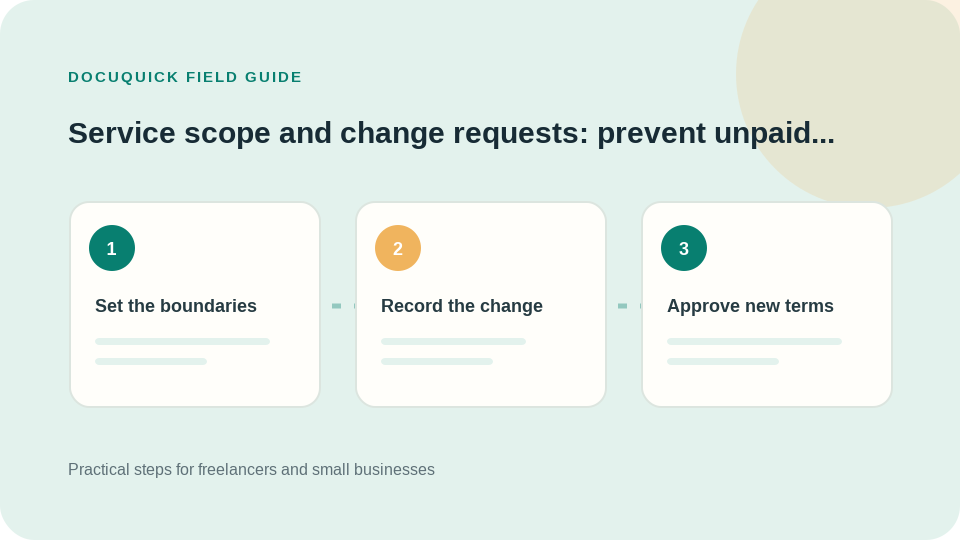
Scope problems often begin with a small phrase: “while you are there,” “make it more polished,” or “we assumed that was included.” The client may see a natural extension of the project; the freelancer may see a new deliverable, extra research, or a schedule change. A clear scope does not prevent every change. It gives both sides a way to identify changes early and decide what to do before time and cost accumulate.
This guide is for service providers who want to describe work clearly and handle revisions without turning every conversation into a negotiation. It covers deliverables, boundaries, acceptance, change requests, and invoice records. Contract interpretation and consumer protections vary by jurisdiction. The examples are practical drafting aids, not legal advice. Check local rules and seek professional review for high-value or regulated services.
Describe outcomes and deliverables
Start with the client outcome, then identify the work you will provide to reach it. A strategy consultant might provide a discovery session, a written assessment, and a decision workshop. A designer might deliver two concept directions, a selected design, two revision rounds, and final files in specified formats. A technician might inspect one location, document findings, and complete listed repairs.
Include measurable details where they matter: quantity, format, dimensions, duration, location, platform, language, audience, or service period. “Create social content” could mean a dozen captions, a campaign calendar, custom artwork, publishing, or paid-ad management. Clarify which of those are included. Avoid describing internal effort as the deliverable if the client is purchasing an outcome; however, effort or hours may be relevant for time-based work.
Set a boundary around what “done” means. Identify the files, handover, tests, or review needed for completion. If a service cannot guarantee a result controlled by the client or a third party, state what you will provide and what outcome you cannot promise. Scope should not imply a guarantee you cannot substantiate.
Define assumptions and client responsibilities
An assumption is a condition used to calculate the fee or schedule. Examples include the client supplying final copy, providing access by a date, naming one approver, or sharing data in a usable format. State assumptions that could materially affect cost or delivery and invite the client to correct them before acceptance.
Client responsibilities can include access, approvals, content, licenses, samples, safety information, and timely decisions. Specify who supplies each item and when. If the client misses a date, explain how the schedule may move. Do not frame ordinary dependencies as automatic grounds for unlimited extra fees. If a delay creates a specific cost, describe the basis and discuss it before incurring it.
Third-party dependencies need separate treatment. A platform outage, printer schedule, permit, supplier, or client’s internal review process may affect delivery. State what you control and what you do not. Include an alternative plan where useful, such as a revised date or a different delivery method if the third party is unavailable.
Distinguish revisions from new scope
A revision improves or adjusts a deliverable within the agreed direction. A change request alters the deliverable, adds work, changes assumptions, or revises timing. The boundary depends on the scope and facts. For a design project, correcting a typo or adjusting a color within the approved concept may be a revision; adding a new product line or changing the target audience may require a new scope.
Define included review rounds. Explain what constitutes one round, such as a single consolidated list from the designated decision-maker. Identify any response window and how conflicting comments will be resolved. Do not impose an unrealistic restriction that prevents you from correcting your own error. Separate client-requested preference changes from rework needed because you failed to meet the agreed specification.
If work is fixed-fee, unlimited revisions are risky unless narrowly defined. A phrase like “revisions as needed” can create different expectations. Define the number and nature of rounds or use a time-based allowance with a cap. Explain how additional rounds will be estimated and approved.
Create a simple change-request process
When a new request arrives, acknowledge it and assess the scope before starting. Compare the request with the approved deliverables and exclusions. Ask what outcome the client needs and whether the request can replace another item, be handled as a separate phase, or be deferred. A change request need not be adversarial; it is a decision point.
Provide a short written change summary:
- Requested change and reason.
- What is included and what is not.
- Additional fee or pricing basis.
- Schedule impact and dependencies.
- Effect on prior approvals or delivered work.
- Required decision-maker and approval method.
- Date the change would become effective.
Wait for approval before doing chargeable extra work unless the agreement explicitly allows another process. A client’s enthusiasm or verbal comment may not be authorization. If a change is urgent, confirm the fee and schedule by an agreed written channel before proceeding.
Example: website project
A small business hires a developer to build a five-page site from client-approved copy and supplied brand assets. The scope includes one contact form, mobile layout, basic browser testing, and two consolidated review rounds. Hosting migration, writing, product photography, translation, and ongoing maintenance are excluded.
During the first review, the client asks for a sixth page and a booking system. The developer identifies these as new deliverables and asks whether the client wants the original launch date preserved. The developer provides two options: add the page now with an adjusted date and price, or launch the original five pages and quote the booking system as a later phase. The client chooses in writing before the developer begins.
Later, the client reports that one button does not work on a tested browser. If the agreed specification included a working button, fixing it is likely a correction, not a paid change. The developer logs the issue, resolves it, and records the retest. This distinction protects the client from paying for a defect and protects the developer from treating a new feature as a defect.
Example: consulting engagement
A consultant agrees to review one department’s workflow and deliver a findings memo plus a workshop. During interviews, the client asks the consultant to analyze a second department. The consultant checks whether the second group was within the original definition of the department. If not, they explain the added interviews and analysis required, give a separate estimate, and wait for approval.
If the client later asks for a short clarification of a finding already in the memo, the consultant can answer within the agreed support period. If the client asks for implementation, staff training, or ongoing monitoring, those are new services. A scope boundary should not prevent reasonable clarification; it should distinguish clarification from a new outcome.
Keep a decision log
Record changes in a lightweight log with date, requester, description, impact, price, approval, and status. Attach the approved change to the original proposal and project record. Update the schedule and invoice plan when needed. A log prevents a long email thread from becoming the only evidence of what was decided.
Use version numbers or dates for revised scopes. Mark which version the client accepted and archive earlier versions. Do not send three documents called “final,” “final-new,” and “final-updated.” A clear history helps both parties understand whether a later invoice reflects approved extra work.
Handle scope creep early and respectfully
Notice signals such as repeated “small” additions, multiple stakeholders sending separate feedback, new deliverable formats, additional locations, or work expanding beyond the defined audience. Raise the issue before it becomes a large unapproved balance. A neutral message can say: “The requested additional location is outside the one-location scope. I can price it as an add-on or keep the current project to the original location. Which would you prefer?”
If a client expects extra work to be included, refer to the accepted scope and ask what outcome they understood. Avoid accusing them of taking advantage. The wording may have been ambiguous, or the client may have relied on a conversation that was not captured. Find the shared facts and agree on a path forward.
Sometimes it is commercially sensible to absorb a very small request. If you choose to do so, label it a one-time courtesy and consider whether it changes the documented scope. Do not do this repeatedly while privately resenting the work; update the package or pricing instead. A courtesy should be a deliberate decision, not an unspoken new standard.
Protect quality while reducing scope
When a client has a fixed budget, identify a smaller outcome that remains useful. Remove optional deliverables, reduce the number of formats, phase the work, or move nonessential tasks to a later stage. Explain the tradeoff. Do not quietly remove safety checks, accessibility, testing, or legal compliance when those are required or important.
Offer alternatives with transparent costs and timelines. A staged approach can provide a usable core first and additional functionality later. Define what must be in place before the next stage begins. Make sure a reduced scope does not still imply the full original outcome.
Change requests and invoicing
Invoice only for the agreed scope and approved changes. Use separate line items for material additions where that improves clarity. Reference the approval date or change identifier. If the project is time-based, show the hours and rate under the agreed terms. Do not add a change fee merely because a request was inconvenient if the agreement does not support it.
If an extra was performed without written approval, discuss it honestly. Do not disguise it as part of an unrelated line. The client may agree to a reasonable amount, dispute it, or decline; seek advice if the contract or local rules are unclear. Adjust future workflow so authorization occurs before the extra work.
Common scope failures
- Using broad labels such as “complete service” without defining outputs.
- Forgetting to specify quantity, formats, locations, or review rounds.
- Treating client delay as automatic authority for a new fee.
- Charging for a correction that should meet the original specification.
- Performing extra work before receiving approval.
- Letting several reviewers create conflicting rounds of changes.
- Promising outcomes controlled by a client or third party.
- Changing scope in email but not updating the invoice plan.
- Using a change process so rigid it blocks reasonable clarification.
- Agreeing to a low budget while leaving the original full scope intact.
A scope review before acceptance
Ask a colleague or client contact to describe what they believe is included. If their answer differs from yours, revise the scope before work begins. Check whether every deliverable has a quantity or acceptance condition, whether exclusions are understandable, whether client responsibilities are realistic, and whether timing includes review. Confirm how changes are requested and approved.
For long-term services, schedule periodic scope reviews. Work patterns change; a package that fit at launch may no longer fit. Compare actual requests with the original scope and decide whether to update the fee, limit the service, or create a separate project.
Closing checklist
- Save the accepted scope, quote, and any governing agreement.
- Name the person authorized to request and approve changes.
- Record each request and classify revision, correction, or new scope.
- Explain fee and schedule impact before beginning additional work.
- Obtain written approval and update the change log.
- Preserve the client’s feedback and delivered versions.
- Match invoice lines to approved work and changes.
- Review patterns and adjust the next proposal where needed.
A change-request conversation that stays constructive
When a client asks for something new, first reflect the request accurately: “You would like the same report prepared for the second region, with the same format as the first.” Then connect it to the agreed boundary: “The proposal covers one region.” Offer a clear choice: price the second region now, replace the original region with it, or defer it to a later phase. This acknowledges the client’s goal while making the scope decision explicit.
If you are unsure whether a request is included, do not improvise a fee in the moment. Say that you will check the accepted scope and reply with the schedule and cost impact. Review the documents, ask a clarifying question, and give the client a reasonable path to approve or decline. This pause protects the relationship better than either silently absorbing significant work or refusing a request based on a vague memory.
Final principle
Scope clarity is a shared operating tool. It helps the client know what to expect and helps the provider deliver quality without silently absorbing a different project. Define outputs, assumptions, review, and dependencies; treat changes as explicit decisions; and invoice only from a reliable approval trail. When the contract or legal boundary is uncertain, consult a qualified professional rather than resolving it through a template.