Credit notes and refunds: correcting invoices without losing the record
2,295 words · 11 min read · Updated 2026-11-26. General information, not legal or tax advice.
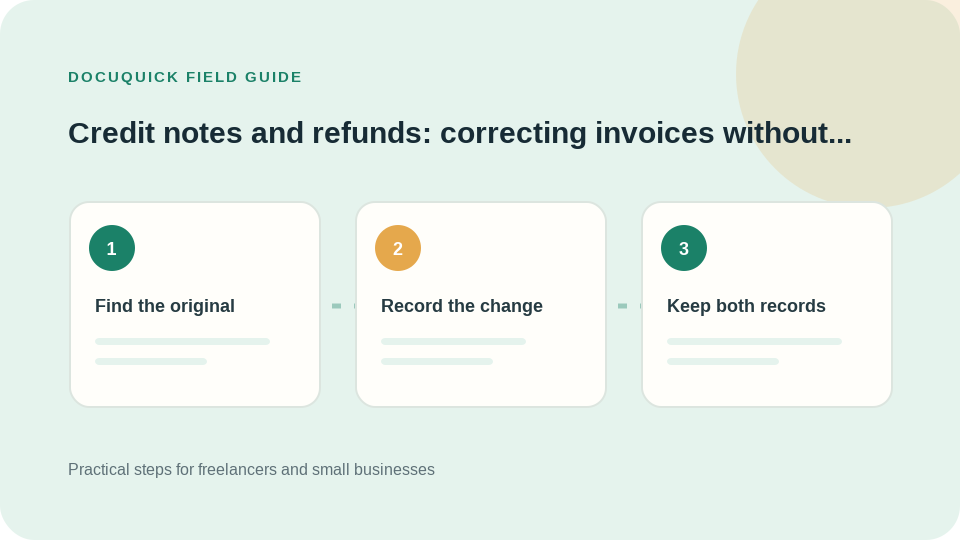
When an invoice is wrong, a client returns goods, a service is cancelled, or an agreed price changes, simply editing or deleting the old document can make the transaction history confusing. A credit note or another formal adjustment can record a reduction while preserving the original invoice. A refund records money returned. They are related events, but they are not the same thing: a credit can reduce an amount owed without cash being returned, and a refund can be made against a payment already received.
The correct document, timing, numbering, tax adjustment, and refund process depend on local law, accounting method, industry, and agreement. This guide is a practical record-keeping overview, not tax or legal advice. Check official requirements or consult an accountant or qualified adviser before changing tax records, correcting a statutory invoice, or deciding whether a customer is entitled to a refund.
Separate the problem from the remedy
Start by identifying what happened. Was the invoice sent to the wrong entity? Was the amount calculated incorrectly? Did the client pay twice? Was a product returned? Was a service partly delivered? Did the parties agree to cancel future work? Was a charge disputed but not yet resolved? The facts determine whether you need a correction, credit, refund, replacement invoice, or simply a payment allocation.
Do not use a credit note as a generic apology or a refund as a substitute for documenting the reason for an adjustment. Record the event, the original agreement, what was delivered, the amount billed, what has been paid, and the decision made. If the issue is a disputed charge, preserve the communication and state which items are agreed and which remain unresolved.
A useful internal note answers four questions: what changed, why it changed, who approved the change, and how the amount was calculated. Link the note to the original invoice and any related contract, return, delivery record, or correspondence. This gives a bookkeeper or adviser enough context to choose the correct accounting treatment.
Credit note, refund, correction, or replacement?
A credit note commonly reduces some or all of an amount previously invoiced. It can correct an overcharge, reflect an agreed discount after invoicing, record returned goods, or cancel a portion of a service charge. It should identify the original invoice and describe the reason and amount of the adjustment. Whether a credit note is the required document is jurisdiction-specific.
A refund is the movement of money back to a payer. It may settle a credit balance or return a duplicate payment. Record the refund date, amount, payment method, reference, and original transaction. If a customer has not paid the invoice, a credit might reduce the balance without a cash refund. If they have already paid, the credit and refund may both be needed in the records.
A corrected or replacement invoice may be appropriate for certain errors, but you should not silently overwrite the version already issued. Preserve the old invoice and make the relationship clear. Some errors require a credit and a new invoice; others may allow a correction document. Consult local rules for required treatment, especially where tax was charged or reported.
A receipt confirms money received or returned, as appropriate to the system; it does not explain why the underlying price changed. Keep it alongside the credit or correction. A payment allocation note may be enough when an invoice is correct but the customer’s transfer was applied to the wrong balance. Do not issue a credit simply to disguise a bookkeeping allocation problem.
Decide the amount carefully
Calculate the adjustment from the agreement and the actual event. If one item is returned, credit that item and any related charges according to the policy and law that apply. If the invoice contains a mathematical error, recalculate the affected lines and tax treatment. If the parties negotiated a price reduction after delivery, record the agreement and make clear whether it applies to the whole invoice or only one component.
For a partial service cancellation, do not automatically divide the fee by calendar days or hours unless that matches the contract and the work performed. Consider the milestones completed, costs incurred, non-refundable third-party expenses, and cancellation terms. Where the parties disagree on entitlement, seek advice rather than using an invoice document to decide a legal dispute.
Check whether the adjustment affects tax, discounts, shipping, fees, or prior deposits. A customer may be owed less than the gross invoice amount because a prior deposit has already been applied. Conversely, an apparent overpayment may be due to a combined transfer covering several invoices. Reconcile all payments before calculating a refund.
Create a clear credit record
If a credit note is appropriate, give it a unique identifier according to your system and date it accurately. Identify the supplier and customer, refer to the original invoice number and date, state the affected lines or service period, show the credited amount and currency, and explain the reason in concise neutral language. Include tax adjustment details required by local rules. Show whether the credit reduces the balance, remains on the customer account, or is to be refunded, if that status is known.
Avoid language that admits fault or makes legal conclusions unless that is the intended and reviewed statement. “Credit for one returned item under order 841” is more useful than “customer unhappy.” Keep the wording factual and respectful. If the adjustment relates to a dispute, it can identify the agreed resolution without implying that unresolved matters are settled.
Send the document through the client’s normal channel and save proof of delivery. Update your accounting system using the proper credit function rather than deleting the original invoice. If the credit changes a submitted tax return or reporting period, ask an accountant how to correct the filing.
Process the refund transparently
Verify the payee and refund destination using a trusted record. If the customer asks to send a refund to a new bank account, confirm the request independently; email accounts can be compromised. Follow payment-provider rules and any consumer-protection requirements. Document the authorization, amount, date, method, and transaction reference. A refund should go to the original payment method when required or safest, unless the applicable process permits otherwise.
Tell the customer what amount is being returned, how it was calculated, when it was initiated, and what reference they can use if it does not appear. Do not promise an exact arrival time if the bank or payment provider controls settlement. If a refund fails or is reversed, retain that status and contact the customer to agree a safe next step.
For a partial refund, explain what remains charged and why. For a full refund, distinguish refunding the invoice payment from cancelling future commitments or returning goods. Those are related but separate actions. Follow the agreement and local law on return shipping, condition, cancellation deadlines, and any fees.
Example: overbilling discovered after payment
A designer invoices a client for two approved formats but accidentally bills three. The client pays the full amount before either side notices. The designer checks the accepted quote, confirms the extra format was not delivered or authorized, and calculates the amount attributable to the extra line plus any relevant tax adjustment. The designer records the error, informs the client, and issues the correction required by their accounting rules.
Because payment has already arrived, the designer then confirms whether the credit will be refunded or applied to another invoice. If refunding, they verify the payment destination and retain the transaction confirmation. The original invoice remains in the file, linked to the credit and refund. The client receives a clear explanation and the updated balance is reconciled.
If the invoice had not been paid, the same credit could reduce the outstanding balance without a cash refund. If the extra format had been delivered after written approval, the charge might be valid instead. The decisive facts are the approved scope and what happened, not the mere fact that a client questioned the line.
Example: cancelled work and a deposit
A photographer receives a booking deposit under an agreement that describes cancellation terms. The event is cancelled. Before calculating a refund, the photographer reviews the agreement, local consumer rules, services already performed, and any approved non-refundable costs. They communicate the proposed calculation and record the client’s response.
If a partial credit is appropriate, it references the deposit invoice and explains the amount retained or returned under the agreed terms. The refund is recorded separately when sent. A receipt for the deposit does not need to be erased; it remains evidence that the payment was received before the cancellation. If the parties dispute the cancellation clause, they should resolve that issue through appropriate advice or process rather than relying on a template.
Correct a document without rewriting history
Make the correction easy to trace. Preserve the original document, create the adjustment or replacement through a controlled process, and link both records. Update the customer balance and the accounting entries; do not make a local file change while leaving the accounting system unchanged. If you send a replacement invoice, label it clearly and tell the client whether it supersedes or supplements the earlier version.
Store the reason and evidence with the correction. Examples include an approved scope change, return authorization, delivery exception, duplicate payment report, or calculation worksheet. Keep only the information relevant to the transaction and protect personal or payment data.
When a client requests a correction to their business name, tax number, or address, confirm what needs to change and whether the document is already reported. A spelling correction may be simple, while changing the billed entity or tax treatment can have consequences. Follow local correction rules before issuing a new document.
Common errors to avoid
- Editing a sent invoice in place and leaving the client’s original copy unexplained.
- Issuing a credit without identifying the invoice it adjusts.
- Refunding money before reconciling deposits, credits, and combined payments.
- Treating a disputed charge as automatically wrong or automatically collectible.
- Recording a refund as a new expense without linking it to the original sale.
- Returning funds to changed bank details without independent verification.
- Crediting a tax amount using the wrong rate or reporting period.
- Deleting a receipt because the payment was later refunded.
- Promising a bank settlement date outside your control.
- Using vague notes that do not identify the reason and calculation.
A correction workflow
- Pause further billing against the affected item while the facts are checked.
- Retrieve the agreement, invoice, delivery evidence, payment history, and messages.
- Identify whether the issue is an error, return, cancellation, credit, or allocation.
- Confirm the amount with a transparent calculation and applicable terms.
- Check tax and document requirements with official guidance or an adviser.
- Obtain approval for a negotiated adjustment where appropriate.
- Issue the credit, replacement, or correction with a unique reference.
- Process any refund through a verified method and record the confirmation.
- Update receivables and accounting without removing the original history.
- Send a concise explanation and retain proof of delivery.
This sequence helps prevent a quick refund from creating a second mismatch. If a customer needs urgent action, you can still communicate promptly while verifying the amount and destination.
Handling refunds when payment providers are involved
Payment providers may charge a processing fee that is not returned when you refund a customer. The commercial agreement and local consumer law determine who bears that cost. Do not deduct it from a refund automatically. Check provider terms and applicable rules, then explain any lawful deduction before processing. If the provider allows only a full refund through the original transaction, record any separate adjustment carefully.
A chargeback is not the same as a voluntary refund. Preserve the provider’s notice, transaction details, customer communication, and evidence of the agreed work or delivery. Respond through the provider’s deadline and process. If you later issue a refund, coordinate it so the customer is not refunded twice while the chargeback is also credited. Ask the provider for guidance when the status is unclear.
A short client message
“Hello [name], I reviewed invoice [number] and confirmed that [brief factual issue]. I have prepared [credit/corrected document] for [amount and currency], linked to the original invoice. The adjusted balance is [amount]. [If applicable: I initiated the refund to the original payment method on date; the provider controls settlement timing.] Please let me know if you would like the calculation or supporting reference.”
Adjust the message to the facts. Do not say a refund was initiated before it was. If you are still investigating, say so and give a reasonable date for the next update. If the client disputes the proposed treatment, keep the conversation specific and preserve the written record.
Review at month end
Compare credit notes, refunds, and original invoices. Confirm every credit has a reason and a reference, every refund has a payment record, and no open balance remains accidentally overstated. Check whether a customer credit is unused and whether it should be refunded or applied under the agreement. Review recurring mistakes, such as a rate configured incorrectly or a duplicate payment link, and correct the process that caused them.
Do not net credits and sales invisibly. Your accounting method should preserve the gross transaction and adjustment in a way that supports reporting and audit. Ask your accountant how your software should represent the events, especially if a credit affects a prior reporting period.
Final principle
A credit note changes the record of what is owed; a refund records money returned. Sometimes both are required, sometimes only one is appropriate, and sometimes the issue is an invoice correction or payment allocation instead. Start with the underlying facts, preserve the original document, and make every adjustment traceable. Confirm local requirements before changing tax or legal records, and communicate the outcome in plain language.