Pro forma invoices: when to use one and how to label it clearly
2,181 words · 10 min read · Updated 2026-11-26. General information, not legal or tax advice.
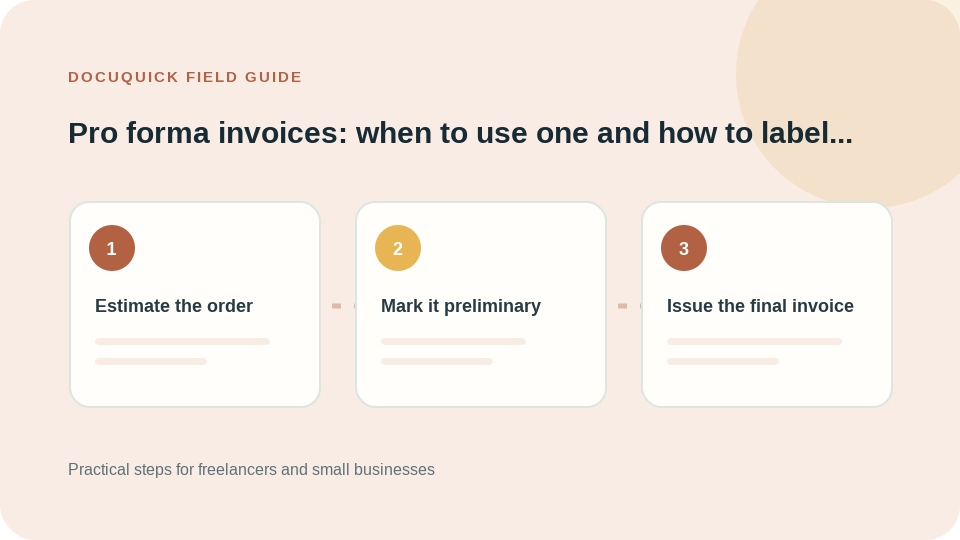
A pro forma invoice is commonly used to present proposed or preliminary transaction details before a final commercial invoice is issued. A business may send one to help a customer arrange approval, payment, shipping, or import documentation. The label is not universal, and customs, tax, and accounting rules can give the document different treatment. Never assume that writing “pro forma” makes a document non-binding, tax-free, or irrelevant to recordkeeping.
This guide is for a small business deciding whether a pro forma document is useful and how to avoid confusing it with a final invoice. It is not legal, tax, or customs advice. Requirements vary by country, industry, goods, and transaction. If a document will be used for customs clearance, tax reporting, regulated goods, or a formal financing decision, confirm the required format and wording with the relevant authority or qualified adviser before sending.
What the document is meant to do
A pro forma document can communicate expected items, quantities, prices, currency, shipping costs, estimated taxes or duties, delivery terms, and other proposed conditions. A buyer may use it to obtain internal purchase approval or to plan a transfer. A seller may use it to communicate what a future invoice is expected to contain. In some trade contexts it may support a preliminary import procedure, subject to the applicable rules.
Its practical role is informational or preparatory, unless the parties and relevant law give it another effect. The document should say what is still provisional and what action the recipient is expected to take. If the recipient is being asked to pay a deposit or prepayment, explain the payment request and legal/accounting treatment clearly. Do not rely on the pro forma label to establish payment terms that were never agreed.
If the parties already agreed the transaction and the amount is due, a regular invoice may be the appropriate document. If payment is received, record the payment and provide a receipt or other confirmation where useful. If you send a pro forma first and a final invoice later, explain the relationship and avoid treating the same amount as two separate liabilities.
How it differs from nearby documents
A quote or estimate proposes scope and price for acceptance. A pro forma invoice often presents transaction-like details in an invoice-style layout, but may be preliminary rather than a final payment claim. A commercial invoice records the actual sale or billing event and is used in the seller’s accounting records according to applicable rules. A receipt records money received. A purchase order records the buyer’s order or authorization. The names and legal effects vary by jurisdiction.
Do not treat these as interchangeable forms. A client who asks for a pro forma may need a cost document for internal approval, or may be using the term for an invoice that they intend to pay. Ask what the document is for, what their procurement team requires, and whether a final invoice is needed later. For cross-border goods, ask whether the document is intended for customs and what exact data the broker or authority requires.
Confirm the purpose before drafting
Start by asking the recipient how they will use the document. Useful questions include:
- Is it for an internal budget or purchase approval?
- Is the customer placing an order, or only comparing options?
- Is payment requested now, and if so, is it a deposit or full prepayment?
- Will a final invoice be issued after shipment, delivery, or completion?
- Is this for customs, import licensing, or another official process?
- Which party is responsible for freight, insurance, duties, and local taxes?
- Does the recipient require a specific template, currency, or reference?
If the answer involves an official filing, verify requirements with the responsible authority or qualified customs/tax professional. A generic document generator may not capture tariff classification, origin, valuation, export-control, or other information required for a particular shipment. Do not guess fields simply because they appear on an example found online.
Prepare a clear preliminary document
Use a prominent title such as “Pro forma invoice” only when that matches the purpose and the recipient’s requirements. Add a date, unique reference, supplier and customer identity, contact details, currency, and a concise description of the proposed goods or services. Include quantities, unit prices, totals, and relevant shipping or service details. Make the estimated or provisional status visible near the total, not hidden in a footer.
State the assumptions that affect the amount. For a goods shipment, that might include quantity, packaging, shipping method, delivery destination, or validity of supplier pricing. For a service, it could include a scope, expected period, or a condition that must be met before final billing. Say which costs are excluded or not yet known, such as import duties or destination charges, if that is accurate and appropriate.
Do not show tax as settled if you have not confirmed the treatment. If you provide an estimate of tax, duty, or freight for planning, label it as such and identify who must verify it. Local requirements may dictate whether those amounts can be shown at all. Never invent a tax registration number, exemption, classification, or customs value.
If payment is not due, do not make the layout look like an urgent payable invoice. You can state “For planning only; not a request for payment” if that reflects the arrangement and is allowed. If payment is due, identify the payment event and terms explicitly and confirm whether a final commercial invoice will follow. The wording must be consistent with your agreement and applicable rules.
Numbering and records
Keep a reference that distinguishes the pro forma from the final invoice series, or otherwise make the relationship unmistakable. Avoid assigning the same invoice identifier to a preliminary document and a final invoice if that could confuse the client or accounting record. If your accounting system creates a formal invoice number only when the transaction is finalized, use a separate quote or pro forma reference beforehand.
Save the exact version sent and record the date, recipient, purpose, and whether the client acted on it. If the customer accepts the transaction, retain the acceptance, purchase order, and any payment confirmation. If the proposal changes, issue a revised version with a new date or revision marker and state which earlier version it replaces. Do not overwrite a sent document without preserving its history.
When issuing the final invoice, compare it line by line with the pro forma and document any differences. Freight, quantities, delivery dates, exchange rates, taxes, and actual services may have changed. Explain changes that affect the final amount. If a customer prepaid based on the pro forma, reflect the actual payment according to the applicable accounting treatment and avoid billing that payment twice.
Example: custom equipment order
A workshop customer asks for a preliminary cost document to request internal approval for a custom equipment order. The seller prepares a pro forma showing the item specification, quantity, unit price, estimated packing and shipping, destination, currency, and the date through which supplier pricing is expected to remain available. Duties at destination are not yet known, so the document clearly says they are excluded and must be confirmed by the buyer’s broker.
The customer’s procurement team approves the amount and sends a purchase order. The parties confirm the delivery details and agree on a deposit. The seller issues the correct payment request under their process, records the deposit when received, and later issues the final commercial invoice based on the goods actually shipped and the final freight charge. The pro forma remains in the file as the preliminary planning record; it is not substituted for the final invoice.
If the quantity changes before shipment, the seller sends a revised preliminary document and gets approval for the revised order. They do not simply ship more units and rely on a later invoice to obtain consent. If an official customs process requires different information, the seller obtains the appropriate guidance rather than treating the original planning document as automatically sufficient.
Example: a service prepayment request
A consultant is asked to provide a short project proposal for a client’s budget review. The consultant sends a priced proposal with a scope and a validity period, not a document styled as a payable invoice. The client approves the work and both sides agree that a portion is payable before scheduling begins. The consultant then sends the appropriate invoice or payment request under the agreed terms, identifying the deposit and how it will be credited in later billing.
In this situation, a pro forma may be unnecessary. If the client’s system specifically requires a pro forma to create a purchase order, the consultant can provide one clearly marked preliminary and explain that the final invoice will be issued at the agreed billing stage. The consultant should not label the full project fee “paid” or tax-final before the transaction and payment status support that statement.
Common mistakes
- Treating “pro forma” as an automatic exemption from tax or invoice rules.
- Sending a preliminary document without asking what the client needs it for.
- Omitting the word “provisional” while making a total look final and immediately due.
- Using an invoice number that later appears again on a final invoice.
- Showing a deposit without explaining how it relates to the final amount.
- Estimating duty or tax without saying who must verify the figure.
- Failing to identify exclusions such as destination charges or shipping.
- Replacing a sent version without retaining the original.
- Assuming a pro forma is sufficient for customs or another official process.
- Sending a final invoice that does not reconcile with the prepayment.
Pre-send review
Before sending, confirm the recipient’s purpose and their required format. Check that the document’s title and status match whether the amount is proposed, approved, payable, or merely for planning. Verify the supplier, customer, items, quantity, currency, calculations, terms, and relevant references. Identify assumptions and exclusions clearly. Confirm what happens next: acceptance, purchase order, deposit, shipment, delivery, or final invoice.
If the document includes a payment request, verify that it is authorized by the agreement and does not create ambiguity about whether the amount is a deposit or full payment. If it will be used for tax, customs, or regulatory purposes, confirm the specific legal fields and treatment. If you cannot confirm a required detail, pause and ask an appropriate professional rather than filling it with a guess.
Handling changes after a pro forma
A preliminary amount can change when a client modifies quantity, destination, options, or timing. Explain the changed assumption and its impact, and issue a revised version before the client commits further where practicable. If the customer has already placed an order or paid, the change may require formal approval or an adjustment under the agreement. Do not assume a pro forma can be revised unilaterally after the buyer has relied on it.
If the transaction is cancelled, record the cancellation and address any deposit or prepayment using the agreement and applicable rules. A pro forma itself does not prove that a refund is due or that funds were received. Keep payment evidence and any credit or refund document linked to the transaction.
Questions to ask when a client requests one
Ask the client whether they need a preliminary cost statement, a formal invoice, a customs document, or a document their purchasing system calls a pro forma. These are not always the same request. Ask whether they intend to pay now, what information their finance team requires, and whether they expect a final invoice later. If goods cross a border, ask who provides customs instructions and what documents the broker requests.
If the client cannot explain the purpose, provide a clear quote or proposal first and invite the procurement or finance contact to confirm required fields. Do not let a familiar document name substitute for understanding how the file will be used. The right format depends on facts and local rules.
A simple internal workflow
Use a consistent workflow: record the request, confirm purpose, prepare a clearly labeled preliminary document, check calculations and assumptions, send it through an approved channel, and save the exact copy with the client response. When the transaction becomes final, create the appropriate invoice and reconcile it to any prepayment. If the transaction does not proceed, mark the preliminary record as not accepted or cancelled without deleting it.
For regular trade, define who can issue these documents and which system creates references. Keep a template with obvious preliminary wording and remove fields that could accidentally mark it paid. Review the template when tax, shipping, payment, or legal requirements change. A template is a control aid, not proof that each transaction is handled correctly.
Final principle
Use a pro forma only when a preliminary, invoice-style document serves a specific purpose. Make its status and next step unmistakable, preserve the version sent, and reconcile it with any final sale, invoice, or payment. Ask what a client means by the term and verify special tax, customs, or legal requirements. Clear labels reduce confusion, but accurate records and appropriate advice determine how the transaction should be treated.