Invoice vs quote vs receipt: what each document does
2,379 words · 11 min read · Updated 2026-11-26. General information, not legal or tax advice.
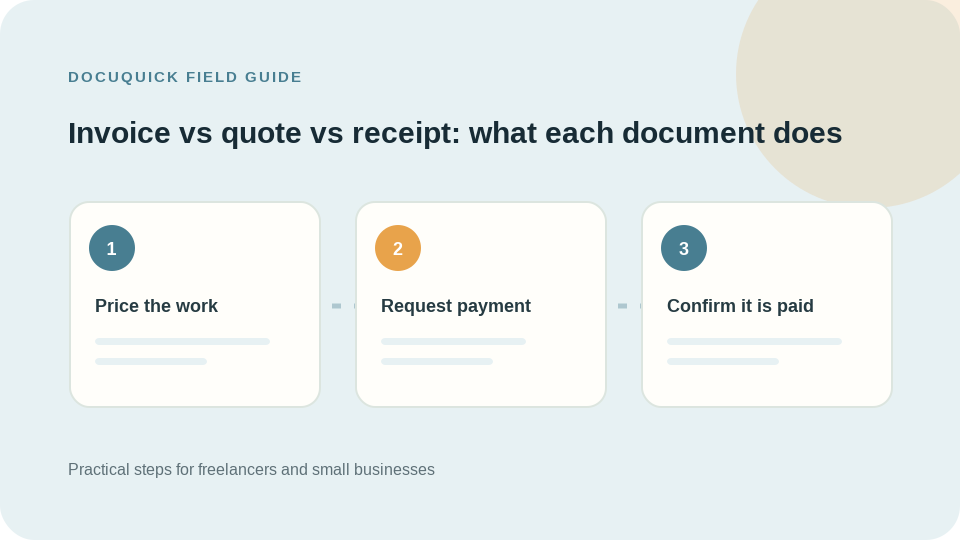
Quotes, invoices, and receipts can all display names, dates, amounts, and business details, but those similarities do not make them interchangeable. A quote or estimate describes proposed work and its expected price before the client commits. An invoice requests or records payment for work, goods, or a billing event under agreed terms. A receipt records that a payment or purchase occurred. Using the right document at the right stage helps prevent misunderstandings about approval, amount due, and payment status.
Terminology and required document fields vary by country, industry, and transaction. In some contexts, words such as “quotation,” “estimate,” “bill,” or “receipt” have specific meanings; elsewhere, businesses use them more loosely. The content and surrounding agreement matter, not just the heading. This guide explains common practical distinctions, not local legal or tax rules. Check official requirements for your business and seek qualified advice when a transaction is regulated or unusual.
The quote: a proposal before commitment
A quote sets out a proposed price and scope so the client can decide whether to proceed. It may include deliverables, quantities, schedule, assumptions, exclusions, validity period, payment terms, and instructions for acceptance. A quote can be fixed or conditional depending on the terms and applicable rules. It should make clear what the client is being offered and how approval happens.
An estimate is often used when the total cost is not yet known. It should distinguish a forecast or range from a guaranteed amount and identify the variables that may affect the final price. Because usage varies, do not assume the word “estimate” alone prevents a price from being binding. Explain the pricing basis in plain language and follow the rules that apply to the transaction.
Use a quote when a client needs to approve a defined piece of work. For a small print job, a quote could identify the number and size of copies, paper choice, finishing, delivery, and any setup fee. For a freelance project, it could specify deliverables, number of review rounds, client-supplied materials, schedule dependencies, and options. A vague headline amount without those boundaries can invite different interpretations.
The quote should not suggest that work is already complete or that money has already been received. It can ask for a deposit as a condition of starting, but explain the amount and timing as part of the proposed terms. If the client accepts, preserve the accepted version and the method and date of approval. A later invoice can then reference the approved work instead of repeating an untraceable verbal understanding.
The invoice: a payment request or billing record
An invoice identifies the supplier, client, billed work or goods, calculation, amount due, relevant dates, and payment instructions. It may include tax information or references required by local law or the client’s accounts process. The invoice should correspond to an agreement, order, or defined billing event. It is not necessarily proof that the client accepted the quote, and sending it does not prove that it reached accounts payable.
An invoice can be due on receipt, payable by an agreed future date, or payable according to installments. The applicable terms should be established rather than invented when preparing the document. For a staged project, an invoice might request an agreed deposit, a milestone payment, or the final balance. Show any prior payments or credits clearly so the client can see what remains due.
An invoice differs from a quote in timing and purpose. A quote asks the client to approve proposed work and price; an invoice asks for payment under the agreed arrangement. A client may require a purchase order before approving the invoice, but a purchase order is another document with its own function. An invoice also does not necessarily serve as a contract. The agreement may be a separate signed document, accepted proposal, order, or other arrangement.
Before sending an invoice, confirm the legal or billing entity, line items, reference numbers, currency, due date, tax treatment, and payment channel. Avoid using an invoice to announce an unapproved price increase or new scope. If a change was approved, reference the change and its agreed amount. If the amount is disputed, address the dispute rather than silently presenting a different version.
The receipt: evidence of a payment or transaction
A receipt commonly confirms that a seller received payment or that a purchase was made. It may identify the date, amount, payment method, items, tax, or transaction reference. A receipt for an invoice should state which invoice or order it relates to and whether the payment settled the full balance or only part of it. It should reflect the payment actually received.
A receipt is not always an invoice. A shop may produce a receipt immediately at purchase, while a freelancer may invoice first and issue a receipt after the client pays. A card authorization, payment-provider notification, bank deposit, and receipt can each describe different stages of payment processing. A transfer may be pending, reversed, or reduced by processing fees. Follow your accounting process before marking the invoice fully paid.
A receipt also does not prove every tax or legal conclusion about the transaction. It can be evidence that money changed hands, but it may not explain the business purpose, item details, contract terms, or tax classification. A customer who needs a document for reimbursement or records may need an itemized receipt or invoice. Check the rules that govern your transactions rather than promising a receipt meets every external requirement.
A simple timeline
Consider a photographer asked to cover a product launch. First, the photographer gathers requirements and sends a quote describing hours of coverage, edited image count, delivery format, date, and optional rush delivery. The client accepts the quote in writing. If a deposit is agreed, the photographer issues an invoice for that amount and records the payment when received. After the event and delivery, the photographer sends a final invoice showing the project fee, deposit already paid, and remaining balance. Once paid, the photographer issues a receipt or marks the invoice paid according to the agreed process.
Each document answers a different question. The quote answers, “What work and price are proposed?” The accepted quote or agreement answers, “What did the parties approve?” The invoice answers, “What amount is being billed now?” The receipt answers, “What payment was received?” The delivery record answers, “What was supplied?” Keeping these records linked prevents a payment confirmation from being mistaken for approval of extra work.
A decision guide for the next document
- The client has asked what a defined service might cost: prepare an estimate or quote.
- The client is still choosing scope: clarify options or quote a discovery stage.
- The client approved work but has not reached a billing milestone: retain the approval; do not imply payment is due unless terms say so.
- The agreed deposit or milestone is due: issue an invoice that identifies that payment stage.
- The work is complete and the final balance is due: issue the final invoice and account for deposits.
- A payment has arrived: record it and provide a receipt or payment confirmation if appropriate.
- The charge needs to be corrected after issue: follow the applicable correction process and preserve the original.
- The client asks for proof of purchase: determine whether an invoice, paid invoice, or itemized receipt meets the actual need.
This decision guide is deliberately practical. Local rules can require specific documents, timing, numbering, or wording. The purpose labels here do not override those requirements.
How documents connect
Use a consistent identifier or reference to connect the proposal, approval, invoice, and payment. A quote number can appear on the invoice, and the invoice number can appear in the receipt or payment note. If your accounting system assigns independent numbers, keep a cross-reference in the record. Do not reuse invoice numbers just to make them match quote numbers.
Preserve the exact version the client accepted. If you send a revised quote, label it as a new version and make clear whether it replaces the previous one. When the client accepts, save the approval message or signed copy. For a change after acceptance, record the changed scope and price before starting the added work.
When a payment is split across several invoices, keep an allocation record. When one invoice is paid in installments, record each amount and date against it. If the client pays a combined balance, the remittance details should show how it was allocated. A receipt with no reference may be impossible to reconcile later.
Common confusions and how to avoid them
Sending a quote as if it were a bill. A proposal can display an amount, but the client may not know whether payment is due now. State clearly whether it is for approval or payment. If a deposit is requested, identify it separately and say what triggers it.
Treating a quote as permission to begin. A quote only leads to a commitment if the client accepts in the agreed way and the relevant terms are satisfied. Save explicit approval and verify any required purchase order, signed contract, or deposit before beginning.
Calling an invoice a receipt. An unpaid invoice does not show payment received. If only a deposit was paid, show the deposit and the remaining balance rather than marking the entire invoice as settled.
Issuing a receipt for a pending transfer. A payment notification can be provisional. Confirm the transaction status under your payment method and correct your records if a payment is reversed.
Assuming a quote includes every possible task. Define the deliverables and exclusions. Work outside the approved scope should be discussed and authorized through a change process, not added to an invoice without warning.
Using a receipt to explain a disputed price. A receipt confirms an event; it does not resolve why the amount was charged. Refer to the agreement, quote, and invoice to explain the basis.
Assuming all clients require the same format. Some organizations need purchase-order details or portal submission. Ask about process early and retain proof of submission.
Example: deposit and final payment
A consultant agrees to a fixed project fee of 2,400, with a 600 deposit at booking and the remainder after delivery. The quote describes the deliverables, schedule, and payment stages. After the client accepts, the consultant sends an invoice for the agreed deposit. The receipt confirms 600 received and references the deposit invoice.
At delivery, the final invoice lists the full project fee, identifies the prior 600 payment, and shows the remaining balance of 1,800. The invoice does not claim that 2,400 is still due. When the balance clears, a receipt can confirm the second payment. The accepted quote, two invoices, two payment records, and delivery evidence tell a consistent story.
If the scope changes and the client approves an additional 300 task, the consultant records the approval and either invoices it under the agreed process or includes it as a separate line on the next invoice. The change should be distinguishable from the original quote. The receipt later confirms payment of the actual amount received; it does not retroactively approve the change.
Document corrections and cancellations
If you find an error in a quote before acceptance, send a corrected version and identify which version is current. If the client accepted the earlier version, do not assume a revised document automatically replaces it. Discuss the change and obtain approval where needed.
If an invoice is wrong, preserve the original and follow the correction method allowed by your jurisdiction and accounting system. That may involve a corrected invoice, cancellation, credit note, or another formal adjustment. Link the correction to the original and explain what changed. Do not delete the original record or silently change its amount after the client has received it.
If a receipt is wrong, correct the payment record without obscuring what actually happened. For example, if an amount was refunded after a receipt was issued, retain the receipt and document the refund separately. A reversal is part of the transaction history, not a reason to pretend the first payment never occurred.
Make each document easy to understand
Put the document type in the title. Give each document a unique identifier appropriate to its series, and date it accurately. Use plain descriptions and clearly distinguish proposed work from completed work. Label currency, tax, payment stage, and balance. Avoid cluttering a quote with fields that only make sense on an invoice, or using an invoice template that says “paid” by default.
When you email a document, summarize its purpose in one sentence. For a quote, ask the client to approve the scope and price or identify questions. For an invoice, state the amount, due date, and reference. For a receipt, confirm the amount and payment date. Keep the message consistent with the document and avoid creating conflicting terms in the email.
Build a reusable transaction checklist
For each project, confirm that you have:
- A record of the client’s request and the agreed scope.
- The quote or proposal sent, including revisions.
- Clear evidence of acceptance and any required purchase order.
- Approval for changes made after acceptance.
- Invoices sent for each agreed billing event.
- Proof that each invoice reached the required channel.
- Payment records, receipts, and allocation details.
- Delivery or completion evidence where relevant.
- Corrections, credits, refunds, or disputes linked to the original records.
Not every project needs every item. The checklist is a prompt to identify what the transaction requires, not a mandate to generate unnecessary paperwork. A simple, low-risk sale may involve one invoice and one payment confirmation. Complex work benefits from a fuller history.
Final principle
Think about the question the document needs to answer before choosing a template. A proposed price belongs in a quote or estimate; a payment request belongs in an invoice; evidence of payment belongs in a receipt. Keep the documents linked to approvals, delivery, and accounting records, and make each one accurate for its own purpose.
If a client asks for a document under a different name, clarify what they need it to prove. They may want an itemized purchase record, a payment confirmation, an invoice addressed to a particular company, or a proposal for internal approval. Use the right content and comply with applicable rules rather than relabeling one document to satisfy a process it does not actually meet.