International invoices and currency: reduce cross-border payment confusion
2,011 words · 10 min read · Updated 2026-11-26. General information, not legal or tax advice.
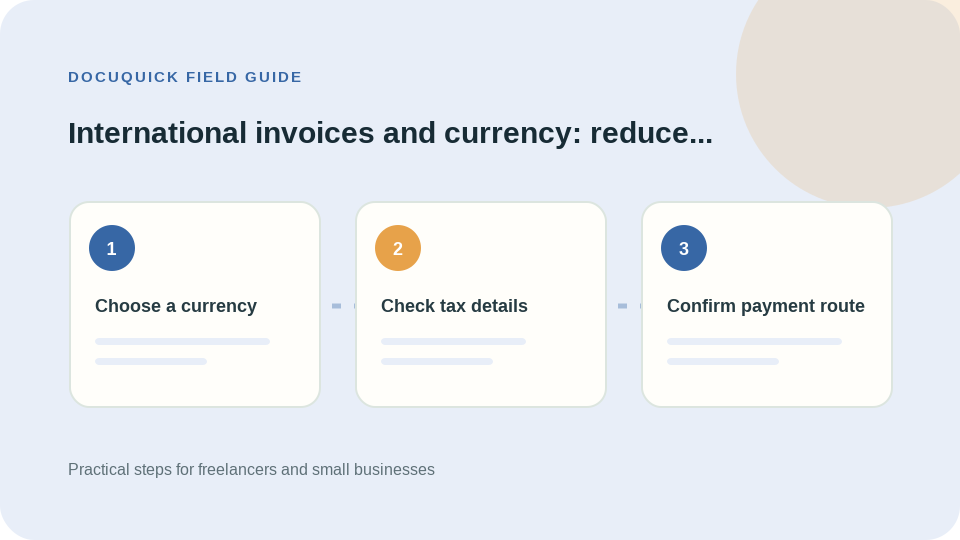
An invoice sent across borders can be delayed by details that seem obvious to the supplier but not to the client: which currency is owed, who pays bank fees, what legal entity is being billed, which tax rules apply, or how the payment should be referenced. A currency symbol alone may be ambiguous, and a transfer can arrive lower than the invoice total because an intermediary bank deducted a fee.
This guide is for freelancers and small businesses invoicing an overseas customer. It covers agreement, currency, payment instructions, documentation, and reconciliation. Cross-border tax, VAT or GST, withholding, customs, foreign-exchange reporting, sanctions, privacy, and invoicing rules are highly dependent on the countries and transaction. The examples are not legal or tax advice. Check official guidance or consult a qualified adviser before determining tax treatment or accepting a regulated payment.
Confirm the parties and transaction
Identify the contracting entity, not just the contact person or familiar brand. A multinational company may have several subsidiaries, and the entity receiving the service may differ from the parent name on an email signature. Ask for the full billing name, registered or billing address, tax identifiers if applicable, purchase order, and submission channel. Verify the information through a trusted contact if it changes unexpectedly.
Describe where the work is performed and where the customer receives or uses it when those facts may affect tax treatment. For goods, delivery location and shipping terms may matter. For digital services, the customer’s location and type can be relevant. Do not infer tax treatment solely from the client’s country or from the fact that the invoice is in foreign currency.
Before accepting a project, confirm whether the client can pay a foreign supplier, which documents their finance team requires, and whether they expect withholding or a local tax invoice. Ask who is responsible for providing certificates or remittance statements. If the client says it must deduct tax, seek advice on how to record gross and net amounts and whether a treaty or registration process applies.
Agree on a currency deliberately
State the currency in the quote or agreement and repeat it on the invoice. Use an unambiguous three-letter currency code alongside the amount, especially where the currency symbol is shared by several countries. A figure such as “$2,000” may mean different currencies; “USD 2,000” is clearer. Do not change the currency after work begins without agreement.
Decide who bears conversion risk. If the fee is fixed in your home currency, the client’s bank may convert at its own rate and charge the client. If the fee is fixed in the client’s currency, you may receive a different home-currency amount as exchange rates move. Make the pricing basis clear and consider whether a quote has a validity period.
For ongoing work, decide whether the exchange rate is fixed for the contract period, updated at each invoice, or handled by the payment provider. If you recalculate a foreign-currency price, state the source and date used when appropriate and verify that the approach is allowed. Do not make an unannounced adjustment based on a rate you selected after the invoice was accepted.
Explain transfer fees and net payments
International transfers can involve sender, intermediary, and recipient-bank fees. Payment platforms may also deduct processing charges or convert currency before settlement. Agree on the intended amount the supplier should receive and who pays each fee, subject to the contract and applicable law. Some transfer systems offer fee-allocation options, but labels such as “shared” or “sender pays” may not guarantee that no intermediary fee will be deducted.
Provide accurate beneficiary details: account holder name, bank name and address if required, account number or IBAN where applicable, routing or BIC/SWIFT information if needed, and any payment reference. Share details securely and only with the intended payer. Be cautious about last-minute changes; independently verify a new account request using a previously known channel.
If the client pays through a platform, test the payment link and disclose any relevant platform fee or conversion arrangement. Never ask a client to pay an unverified intermediary. The invoice should describe the accepted methods and any fee allocation clearly enough that the client knows the expected process before payment.
Add references the client needs
A foreign customer may need a supplier identifier, tax number, purchase-order code, project reference, or bank payment code. Ask for required fields during onboarding and place them where the customer’s accounts team expects. A correct invoice may still be rejected if the buyer cannot match it to an approved order.
Use the client’s requested legal name and address exactly. If a local-language description or a translated copy is required, ask whether the translation must be certified or whether a bilingual description is sufficient. Do not translate a statutory tax term casually if a precise local meaning matters.
Review tax treatment before billing
Cross-border supplies can involve local registration thresholds, reverse-charge mechanisms, withholding taxes, import duties, place-of-supply rules, or special invoice wording. The facts can include supplier location, customer status, service type, delivery location, and the timing of the transaction. A general online template cannot determine all these details.
Do not charge or omit tax based solely on a client request. Verify the applicable rule through official tax authority guidance or a qualified accountant. Confirm whether the invoice must show a registration number, a reverse-charge statement, an exemption basis, tax amount, or other prescribed text. Keep evidence supporting the customer’s business status or location if your rules require it.
If withholding is expected, ask how the client will document the deduction and remit it. The invoice may show the gross amount due while the payment record shows the amount withheld, but the correct handling depends on local rules and your accounting system. Obtain the official certificate or remittance evidence and consult an adviser before treating the shortfall as an ordinary unpaid balance.
Example: service billed in the client’s currency
A consultant based in one country agrees to a project fee of GBP 3,000 with a client whose accounts team pays in pounds. The written quote says the fee is in GBP and explains the payment method. The consultant asks for the client’s legal entity name, billing address, purchase-order number, and required tax wording before work begins.
The invoice repeats “GBP 3,000,” uses the supplied entity details, and references the accepted quote and purchase order. The client sends a bank transfer but chooses an option that allows intermediary fees. The receiving bank deposits GBP 2,975. The consultant checks the transfer record, identifies a GBP 25 intermediary fee, and records the gross settlement and fee according to the accounting method and agreement.
The consultant does not automatically add GBP 25 to the next invoice. First they confirm who was responsible for charges and whether the agreement and law permit recovery. For future projects, they explain the expected fee allocation before acceptance and may use a payment channel with clearer fee disclosure.
Example: domestic currency price paid internationally
A designer prices a service in their home currency, CAD 1,500, for an overseas client. The client asks to pay in EUR. Before agreeing, the designer decides whether to accept the original currency through a provider conversion or to issue a euro amount using a defined rate and date. The parties document the choice and who bears conversion costs.
If the price is converted to EUR, the designer records the rate source, conversion date, and agreed euro total in the project file. The invoice states EUR, not a bare symbol, and the payment link uses the same amount. The designer reconciles the provider’s settlement and fee separately. If the rate changes before payment, the designer follows the agreed terms rather than recalculating without notice.
Make the invoice readable internationally
Use an unambiguous date format, such as a written month or another format the client confirms. State the time period and due date clearly. Specify quantity, unit, currency, and decimal conventions; different locales use commas and periods differently. Keep line descriptions concise and avoid idioms that may not translate.
Include contact details for billing questions and identify the preferred communication channel. A client abroad may need time to obtain approvals, convert funds, or comply with local banking rules, so factor those steps into the agreed schedule without making unsupported promises. Avoid exposing personal identification or bank information beyond what the payment route requires.
Track the exchange rate in your records
Keep both the invoice currency and the amount received in the settlement currency. Save the payment provider’s transaction statement, rate, date, and fees. Record how your bookkeeping system handles exchange differences and when it recognizes them. The correct accounting treatment may depend on reporting standards and local tax rules; use professional guidance rather than inventing a conversion method.
Do not overwrite a foreign-currency invoice with a home-currency value after settlement. Preserve the original amount and record the actual settlement separately. If a client pays several invoices in one transfer, keep the remittance allocation and conversion evidence for each amount.
A cross-border preflight checklist
- Confirm the exact legal client entity, address, and invoice recipient.
- Agree on the currency and state its code in the quote and invoice.
- Identify transfer method and how sender, intermediary, and receiving fees are handled.
- Obtain required purchase-order, supplier, project, and bank references.
- Verify tax treatment and required invoice wording with a reliable local source.
- Confirm whether withholding is expected and what evidence will be supplied.
- Use clear dates, quantities, units, and decimal conventions.
- Protect bank details and independently verify changes.
- Retain the exchange rate, provider fees, and settlement evidence.
- Check the client’s portal acceptance rather than assuming email submission is sufficient.
Common cross-border errors
- Using a symbol such as “$” without naming the currency.
- Billing a parent company when a local subsidiary is the contracting entity.
- Assuming a foreign customer means no tax is due.
- Ignoring withholding or recording only the net deposit.
- Sending payment details to an unverified recipient.
- Changing the exchange-rate basis after a quote is accepted.
- Omitting an order reference required by the buyer’s system.
- Confusing an intermediary bank deduction with a client underpayment.
- Treating a payment platform conversion as the official accounting rate without checking policy.
- Using a generic customs or tax statement without validating it.
If a payment is late or short
First reconcile the invoice, transfer reference, bank statement, and provider report. Ask for a remittance advice if the amount cannot be identified. Determine whether the short amount is due to a fee, withholding, exchange movement, partial payment, or mistake. Each has a different treatment.
If the payer deducted tax, request the formal withholding certificate and check the applicable reporting approach with your adviser. If a bank fee was deducted, refer to the agreed fee allocation. If the currency conversion differs from the quote, compare the transaction with the agreed rate rule. Do not label every discrepancy “unpaid” or waive every shortfall without understanding it.
Protect against payment fraud
Cross-border invoicing can involve impersonation, altered bank details, and fake payment confirmations. Confirm account changes by calling a known number or using a previously established secure channel. Check the sender address carefully, but do not rely on email appearance alone. Verify that funds have actually settled before issuing a paid receipt or delivering work if payment is a condition.
Never open unexpected attachments or links merely because they mention an invoice. Confirm unusual requests directly with the client. Share only necessary bank data and store it securely. If a transfer is recalled or reversed, preserve the provider notice and seek advice about the appropriate accounting and customer communication.
Final principle
An international invoice should remove ambiguity, not pretend that cross-border complexity is simple. Agree on the currency, fee allocation, entity, references, and payment route in advance. Verify tax or customs details with authoritative local guidance, and keep both the invoice amount and actual settlement record. Clear terms make reconciliation possible even when banks, currencies, and approval systems differ.